
R1-Zero: Pure RL, No SFT
The DeepSeek-R1 paper has two models:
- R1-Zero: base model + RL directly, no supervised fine-tuning
- R1: SFT cold start → RL → rejection sampling → more SFT → more RL
R1-Zero is the scientifically interesting one: applied directly to DeepSeek-V3-Base with GRPO, it develops reasoning behaviors — self-verification, reflection, long chains of thought — without any demonstration data.
GRPO: Group Relative Policy Optimization
PPO needs a separate value model (about one extra model’s memory). GRPO drops it: sample G outputs per prompt from the old policy, use the group’s mean as baseline:
$$A_i = \frac{r_i - \text{mean}(r_1, \ldots, r_G)}{\text{std}(r_1, \ldots, r_G)}$$This turns the advantage estimate into a group-relative comparison, removing the critic network entirely.
Rule-Based Rewards
For math/code, rewards are verifiable:
- Correctness: exact-match or unit tests pass
- Format: response contains ``` reasoning tags and answer tags
No learned reward model → no reward hacking against a proxy. The model cannot fool a unit test.
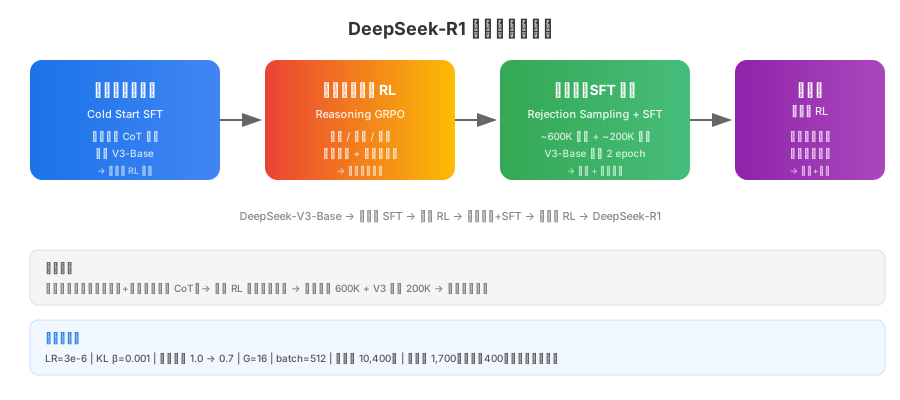
Figure 1: R1 training pipeline — cold start, RL, rejection sampling, second RL round
Emergent Behaviors in R1-Zero
Training curves show the “aha moment”: around a certain RL step, response length jumps and accuracy climbs discontinuously. Behaviors that appear without being rewarded:
- Self-verification: “Wait, let me check this again…”
- Backtracking: abandoning a failed approach mid-solution
- Reflection: explicitly stating assumptions and testing them
The paper’s interpretation: given only correctness rewards and enough exploration, chain-of-thought is the most natural path to correct answers.
Why R1 (the Two-Stage Version) Is Still Needed
R1-Zero has problems: non-English mixing, endless repetition, weak instruction following. The full R1 pipeline fixes these:
- SFT cold start (thousands of long-CoT examples) — gives the model a usable format
- Reasoning RL — GRPO on verifiable tasks
- Rejection sampling + SFT — generate diverse reasoning data, filter by correctness, retrain
- Second RL round — now including human-preference rewards for helpfulness and harmlessness
Results
| Benchmark | DeepSeek-V3 | R1-Zero | R1 |
|---|---|---|---|
| AIME 2024 | 39.2 | 71.0 | 79.8 |
| MATH-500 | 90.2 | 95.9 | 97.3 |
| Codeforces (percentile) | 58.7 | — | 96.3 |
| GPQA Diamond | 59.1 | — | 71.5 |
R1 matches OpenAI o1-1217 on AIME and MATH.
Why This Matters
- Reasoning is learnable by RL — no process-supervision data (as o1 likely used) required, outcome rewards suffice
- Open replication — the recipe, code, and weights are all open, unlike o1
- The efficiency question — R1 achieves o1-level results with a much smaller infrastructure budget, challenging the “scale is everything” narrative
Limitations
- Language mixing persists in long reasoning chains
- Sensitive to prompt format (the paper itself notes format brittleness)
- RL for general domains (writing, open-ended QA) still needs preference models, where reward hacking returns
References
- DeepSeek-AI (2025). DeepSeek-R1: Incentivizing Reasoning Capability in LLMs via Reinforcement Learning. arXiv:2501.12948.
- Shao, Z., et al. (2024). DeepSeekMath: Pushing the Limits of Mathematical Reasoning (GRPO origin). arXiv:2402.03300.