
Prologue: The Gaps in BERT and GPT
By 2018-2019, NLP was split across two lines:
- BERT (encoder-only): strong bidirectional understanding, but cannot generate
- GPT (decoder-only): strong generation, but unidirectional attention hurts understanding tasks
Could one architecture do both? The answer is encoder-decoder — the original Transformer, which BERT and GPT each tore apart.
In 2019, Google’s T5 and Facebook’s BART gave two different but complementary answers.
T5: Everything Is Text-to-Text
T5 (Text-to-Text Transfer Transformer) made a radical claim: rewrite every NLP task as “input text → output text”.
| Task | Input | Output |
|---|---|---|
| Translation | translate English to German: That is good. |
Das ist gut. |
| Classification | sst2 sentence: This movie is great. |
positive |
| Similarity | stsb sentence1: ... sentence2: ... |
3.8 |
| Summarization | summarize: <long text> |
<summary> |
The model needs no task-specific output layer — classification emits the token sequence “positive”, regression emits the numeric string “3.8”. What’s unified isn’t the architecture, it’s the interface.
Relative Position Encoding
T5 uses a simplified relative position bias: each attention head learns a set of scalar biases indexed by query-key relative distance, added to attention scores. Compared to absolute positions, it extrapolates better to unseen lengths.
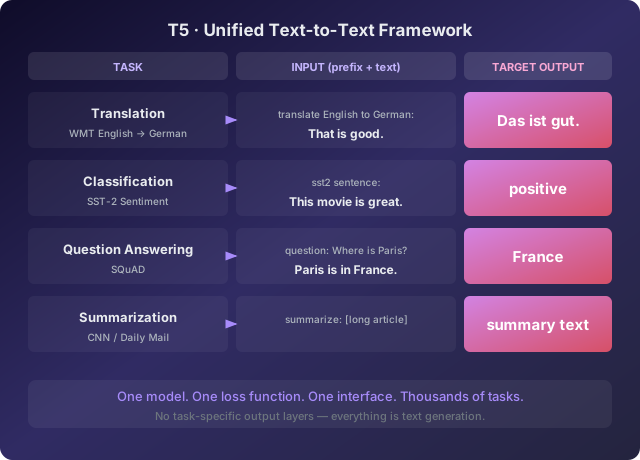
Figure 2: T5 unified Text-to-Text framework — translation, classification, QA, summarization all mapped to prefix text → target text
Pretraining Objective: Span Corruption
T5 doesn’t mask individual tokens like BERT — it masks contiguous spans:
|
|
Each span is replaced by a sentinel token (<X>, <Y>), and the model must emit all masked spans. Average span length 3, 15% masked.
This is harder than token masking and closer to a generation task.
The C4 Dataset
T5 built C4 (Colossal Clean Crawled Corpus, 750GB) — English text cleaned from Common Crawl. Rules included: keep only lines ending in punctuation, deduplicate, filter profanity pages.
Model Sizes
| Model | Params | Layers | d_model |
|---|---|---|---|
| T5-Small | 60M | 6/6 | 512 |
| T5-Base | 220M | 12/12 | 768 |
| T5-Large | 770M | 24/24 | 1024 |
| T5-3B | 3B | 24/24 | 1024 |
| T5-11B | 11B | 24/24 | 1024 |
One of T5’s most valuable contributions is its systematic ablation study: encoder-decoder vs decoder-only, denoising vs language modeling objectives, C4 vs other datasets, pretraining data volume. The conclusion: encoder-decoder + span corruption wins at equal compute budget.
BART: A Denoising Autoencoder
BART (Bidirectional and Auto-Regressive Transformer) takes a different angle: corrupt text with arbitrary noise, then reconstruct the original.
Its structure is the full Transformer encoder-decoder:
- Encoder uses bidirectional attention (like BERT)
- Decoder uses causal attention (like GPT) plus cross-attention over encoder output
Five Noise Types
BART tested several noise functions; the best combination was:
- Token Masking: random token masking (same as BERT)
- Token Deletion: random deletion — the model must infer both position and content
- Text Infilling: mask contiguous spans with a single mask (same as SpanBERT)
- Sentence Permutation: shuffle sentence order
- Document Rotation: rotate the document, forcing the model to find the true start
The final configuration used text infilling + sentence permutation: 30% of tokens masked (span lengths Poisson λ=3), with sentences shuffled.
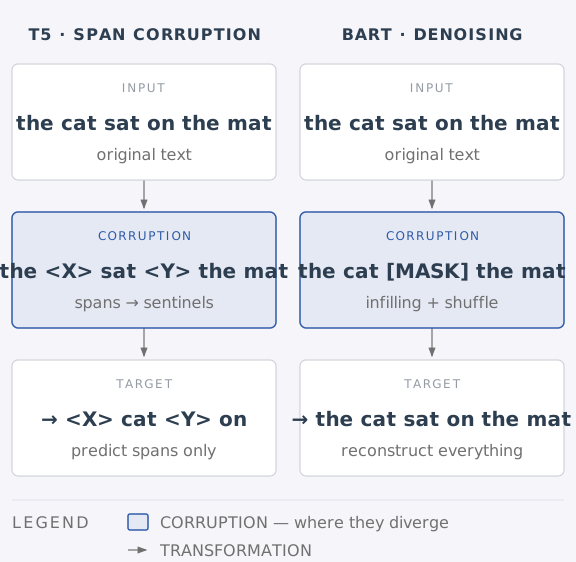
Figure 1: T5 span corruption vs BART denoising reconstruction (generated with Diagram Design)
Why BART Excels at Generation
BART’s decoder is autoregressive, so it naturally does summarization, translation, and dialogue. Its encoder is bidirectional, so it fully understands the input. This combination is especially strong for summarization — BART beats T5 on XSum.
T5 vs BART
| Dimension | T5 | BART |
|---|---|---|
| Architecture | Encoder-Decoder | Encoder-Decoder |
| Objective | Span corruption (predict masked spans) | Denoising reconstruction (rebuild the whole input) |
| Corruption | Contiguous spans → sentinels | Text infilling + sentence shuffle |
| Strength | Classification, translation, multi-task unification | Summarization, generation |
| Position encoding | Relative position bias | Learned absolute positions |
| Scale | 60M - 11B | 140M - 400M |
Core difference: T5 predicts only the corrupted parts; BART reconstructs the full sequence. The former is more compute-efficient, the latter more generation-friendly.
The Rise and Fall of Encoder-Decoder
After 2020, decoder-only became dominant (GPT-3, LLaMA, DeepSeek are all decoder-only). Why?
- Scaling efficiency: no encoder-decoder communication overhead; same parameter count buys more depth
- Training simplicity: one language-modeling objective, no noise design needed
- Generality: in-context learning lets “understanding” tasks be solved by generation too
But encoder-decoder didn’t vanish: T5 remains the backbone of many RAG, translation, and summarization systems, and Flan-T5 is still a strong choice among open small models.
Reading NoteThis article covers T5 and BART (2019-2020), both encoder-decoder architectures. Decoder-only has dominated since 2022, but understanding T5/BART’s design is crucial for understanding why that shift happened.
My Take
- Span corruption’s success is partly coincidental. T5’s ablation studies showed it worked best on original benchmarks, but Flan-T5 later used the exact same T5 checkpoint for instruction tuning — nobody proved span corruption is superior to text infilling for that setting. It won by empirical luck, not theoretical necessity.
- T5’s most underappreciated contribution is C4, not the model. The 750GB cleaning pipeline (sentence boundaries, dedup, language filtering) was reused by many later projects. Yet almost nobody cites T5 for C4 — everyone talks about text-to-text.
- Encoder-Decoder’s greatest value today is explaining why decoder-only won. Reading T5 and GPT-3 side by side, you see cross-attention becomes a scaling bottleneck. That’s not T5/BART’s failure — it’s a validated negative result that helped the field move forward.
Takeaways
- Unified interface > unified architecture: T5’s text-to-text proved the value of a common interface — an idea inherited by instruction tuning
- The denoising design space is large: T5’s span corruption and BART’s text infilling are both denoising, but details determine task fit
- Ablation studies are rarer than architecture novelty: T5’s most valuable artifact is that ablation table, not the model itself
References
- Raffel, C., et al. (2019). Exploring the Limits of Transfer Learning with a Unified Text-to-Text Transformer. arXiv:1910.10683.
- Lewis, M., et al. (2019). BART: Denoising Sequence-to-Sequence Pre-training for Natural Language Generation, Translation, and Comprehension. arXiv:1910.13461.
- Hugging Face T5 docs: https://huggingface.co/docs/transformers/model_doc/t5